
How to Choose Futures Fins: The Complete Guide for Every Surfer
Futures Fins have become the go-to choice for professional and recreational surfers worldwide. Their single-tab fin box system provides a secure, reliable connection that prevents broken fin bases while making fin changes quick and simple. Whether you're surfing small waves in Waikiki or tackling solid North Shore swells, selecting the right Futures fins can dramatically improve your surfing performance.
This guide breaks down everything you need to know about choosing Futures Fins—from understanding the Ride Number system to selecting the right construction type for your surf conditions. By the end, you'll have the knowledge to confidently pick fins that match your style, weight, and the waves you ride.
Understanding the Futures Fins Ride Number System
The Ride Number is Futures' proprietary performance rating system that simplifies fin selection. It uses a scale from 1 to 10, where each number represents a specific feel and performance characteristic based on the fin's flex, rake, and foil.
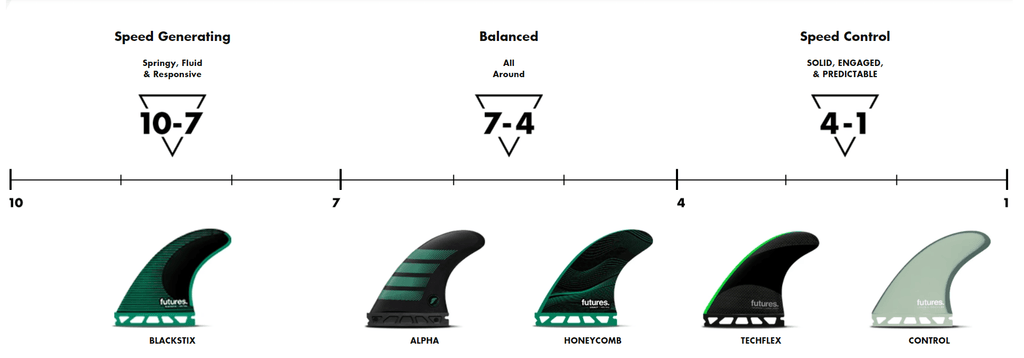
Here's how the Ride Number scale breaks down:
Ride Number Categories
Speed Generating (Ride Number 7-10)
Fins in this range feel springy, fluid, and responsive. They're designed for smaller, weaker waves or light-footed surfers who need to generate speed. The increased flex provides that extra spring through turns, making them exceptional at creating momentum when conditions lack power.
Best for: Small to medium waves, generating speed, light-footed surfers
Balanced (Ride Number 4-7)
These fins offer a blend of speed generation and control. They perform well on bigger days while still feeling loose and lively on average, everyday waves. Balanced fins let your board's original characteristics shine without adding extreme directional influence.
Best for: All-around performance, everyday conditions, versatility
Speed Control (Ride Number 1-4)
Fins with lower Ride Numbers feel solid, engaged, and predictable. They're designed for powerful surfers and powerful waves where controlling speed is essential. The stiffness allows them to engage and be pushed hard when carving at high speeds.
Best for: Large waves, powerful surf, speed control at high velocities
Quick tip: Remember this simple rule—when you're pumping, choose Speed Generating fins. When the waves are pumping, choose Speed Control fins.

Click image to enlarge
Futures Fins Construction Types Explained
Futures offers several construction types, each engineered for specific performance characteristics. Understanding these differences helps you match fins to your surfing conditions.
Blackstix Construction
Ride Number Range: 7-10
Material: Carbon Fiber
Feel: Speed Generating
Blackstix fins feature carbon fiber construction that delivers maximum flex and responsiveness. The flexible nature creates a springy feel through turns, generating speed even in weaker conditions. These are ideal for small to medium surf where you need every bit of momentum you can create.
Honeycomb Construction
Ride Number Range: 4-7
Material: Fiberglass with Honeycomb Core
Feel: Balanced
Honeycomb fins provide the perfect middle ground. The fiberglass exterior combined with a honeycomb core delivers medium flex with predictable performance. These fins work well in most conditions, making them excellent all-around options for surfers who want one versatile fin set.
Techflex Construction
Ride Number Range: 3-4
Material: Lightweight Composite
Feel: Speed Control
Techflex fins are engineered for control in larger surf. They're lightweight yet stiff, providing the hold and stability needed when waves have power. Professional tour riders often choose Techflex for step-up boards and solid swells.
Control Series Construction
Ride Number Range: 1-4
Material: Solid Fiberglass
Feel: Maximum Speed Control
Control Series fins deliver the stiffest, most predictable feel in the Futures lineup. Built with solid fiberglass, they excel in powerful, consequential waves where maintaining control at high speeds is critical. These fins pair perfectly with guns and step-ups.
Alpha Construction
Ride Number Range: Varies by template
Material: Carbon-Infused Composite with NetPlus™
Feel: Precision Performance
Alpha construction uses a carbon-infused composite that includes NetPlus™ material made from recycled fishing nets. This eco-conscious construction delivers lightweight sensitivity while maintaining durability. Alpha fins are crafted using 3D-printed molds for accuracy and consistency.
Fin Templates: Rake, Pivot, and Neutral
Beyond construction, Futures Fins are categorized into three distinct template shapes. Each template affects how the fin performs through turns and down-the-line surfing.
Rake Fins (Drive Template)
Rake fins have a more swept-back design with the tip positioned further behind the base. This shape provides:
- Extra drive through turns
- Stability in larger surf
- Longer, drawn-out arcs
- Better hold on open faces
Best for: Point breaks, carving surfers, powerful waves with long walls
Pivot Fins (Quick Release Template)
Pivot fins have a more upright profile with less sweep. This design delivers:
- Tighter turn radius
- Quick release out of turns
- Responsive feel in the pocket
- Snappier surfing in weaker waves
Best for: Beach breaks, pocket surfing, quick, vertical maneuvers
Neutral Fins (All-Around Template)
Neutral fins balance the characteristics of rake and pivot templates:
- Versatile performance across conditions
- Blend of hold and release
- Predictable, reliable feel
- Works well on various board types
Best for: All-around surfing, mixed conditions, versatile quivers
Understanding Flex, Rake, and Foil
| Flex | Rake | Foil |
|---|---|---|
| How much the fin bends under pressure. More flex = springy feel. Less flex = solid feel. | The sweep angle of the fin. More rake = drive and hold. Less rake = pivot and release. | The cross-section shape. V foils generate speed. Flat foils control speed. |
Futures Fins Size Guide by Weight
Choosing the correct fin size is essential for optimal performance. Futures Fins uses a sizing system based on surfer weight. Here's the breakdown:
| Fin Size | Surfer Weight (lbs) | Surfer Weight (kg) |
|---|---|---|
| X-Small (Grom) | 75 - 115 lbs | 34 - 52 kg |
| Small | 105 - 155 lbs | 48 - 70 kg |
| Medium | 145 - 195 lbs | 66 - 88 kg |
| Large | 180 lbs and above | 82 kg and above |
Note: You'll notice some weight overlap between sizes. If you fall in an overlap zone, consider your surfing style:
- Size down if you prefer a looser, more responsive feel
- Size up if you want more hold, drive, and stability
Choosing Futures Fins for Different Wave Conditions
Matching your fins to wave conditions helps you get the most out of every session. Here's a practical guide:
Small to Medium Waves (Waist to Head High)
When waves lack power, you need fins that help generate speed. Choose:
- Blackstix construction (RN 7-10)
- Pivot or neutral templates
- Fins with V or V2 foils for lift
Average Everyday Conditions
For typical surf days, balanced fins provide the most versatility:
- Honeycomb construction (RN 4-7)
- Neutral templates
- Standard flex patterns
Solid Swells and Powerful Waves
When the surf has push, you need fins that control speed and provide hold:
- Techflex or Control Series construction (RN 1-4)
- Rake templates for drive
- Flat foils for predictable engagement
The ability to swap fins based on conditions is one of the biggest advantages of removable fin systems. Having multiple fin sets effectively expands your quiver without buying additional surfboards.

Click image to enlarge
Pro Signature Futures Fins
Futures collaborates with top shapers and professional surfers to develop signature fin models. These fins are designed to complement specific surfing styles and board designs:
Shaper Signatures
- Al Merrick – Designed for Channel Islands boards, optimized for high-performance shortboards
- Dan Mann – Engineered for Firewire shapes, emphasizing speed and flow
- Matt Biolos (Mayhem) – Tuned for Lost surfboards with emphasis on responsiveness
- Pyzel – Developed for Jon Pyzel's designs
- Hayden Shapes – Optimized for Hayden Cox's innovative board designs
Pro Rider Signatures
- John John Florence (JJF) – Available in multiple constructions, designed for high-performance surfing
- Jordy Smith – Known for powerful surfing, his fins emphasize drive and control
- Rob Machado – Single fin and alternative designs for smooth, flowing surf style
Frequently Asked Questions About Futures Fins
What makes Futures Fins different from other fin systems?
Futures Fins use a single-tab fin box system that provides a secure, stable connection. The single slot design prevents broken fin bases and makes installation straightforward. The system is trusted by professional and recreational surfers worldwide for its reliability and performance consistency.
How do I know what size Futures Fins to buy?
Futures Fins sizing is based on your body weight. X-Small fits 75-115 lbs, Small fits 105-155 lbs, Medium fits 145-195 lbs, and Large fits 180 lbs and above. If you're between sizes, size down for a looser feel or size up for more hold and stability.
What is the Ride Number system?
The Ride Number is Futures' performance rating system on a scale of 1-10. Numbers 7-10 indicate Speed Generating fins that feel springy and responsive for smaller waves. Numbers 4-7 are Balanced fins for all-around use. Numbers 1-4 are Speed Control fins that feel solid and predictable for powerful waves.
Which Futures Fins construction is best for small waves?
Blackstix construction (Ride Number 7-10) is best for small waves. The carbon fiber material provides maximum flex, creating a springy feel that helps generate speed when waves lack power. These fins excel in gutless conditions where you need to create your own momentum.
What fins should I use for big waves?
For big, powerful waves, choose Techflex (Ride Number 3-4) or Control Series (Ride Number 1-4) fins. These stiffer constructions provide the hold and control needed at high speeds. Rake templates work well in larger surf, offering drive through longer, drawn-out turns.
Can I change Futures Fins based on surf conditions?
Yes, swapping fins based on conditions is one of the biggest advantages of removable fin systems. Having different fin sets for small waves versus solid swells effectively expands your quiver without buying additional surfboards. Many surfers keep multiple fin sets to dial in performance for any conditions.
What is the difference between rake, pivot, and neutral fin templates?
Rake fins have a swept-back design that provides drive and hold for longer turns—ideal for point breaks. Pivot fins are more upright, offering quick release and tight turns—great for beach breaks. Neutral fins balance both characteristics for versatile, all-around performance.
Which pro surfers ride Futures Fins?
Futures Fins has signature models with world-class surfers including John John Florence, Jordy Smith, and Rob Machado. They also collaborate with elite shapers like Al Merrick, Dan Mann, Matt Biolos, Pyzel, and Hayden Cox to develop performance-tuned fin designs.
Shop Futures Fins at Hawaiian South Shore
Ready to find your perfect Futures Fins? Hawaiian South Shore carries a complete selection of Futures fin sets, from Speed Generating Blackstix to Speed Control Techflex and everything in between. Our team has decades of experience helping surfers in Hawaii match fins to their boards, style, and local conditions.