
Making Waves: Kevin Schulz’s Take on the S Boss Surfboard
Dan was in Costa Rica when David called. He was deep into R&D on board designs, but he hopped on a Zoom to walk through the S Boss — how it started, what Kelly wanted, and why the design works the way it does. That conversation is in the video below.
The S Boss is a collaboration between Kelly Slater and shaper Dan Mann. The idea started in 2020 at the Firewire factory during the COVID shutdown — the building was empty, the two of them were talking board design, and Kelly laid out something he'd been thinking about. He wanted a shorter board with less swing weight and a more parallel outline. He wanted to feel the board turn from the rails, not just the rocker. And he wanted a bottom contour unlike anything they'd built before: vee under the chest, giving way to a double barrel, then concave out the tail.
Dan was skeptical. He'd always believed vee created drag — that it put a cap on how fast a board could go. But when he put all the pieces together and they tested it, the combination worked. The double barrel near the fin cluster broke the board into two sections, and what you got was the speed of a shorter, lighter board with the ability to draw turns out or snap them quick in the pocket.
How the Outline Came Together
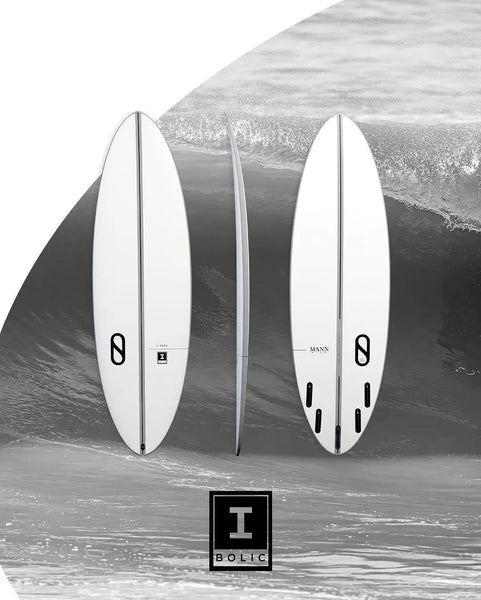
The most visible thing about the S Boss is the nose — it's a bullet. Dan describes it this way:
That bullet nose allows for the last little bit, two or three inches of the nose to be essentially chopped off. So you can ride a shorter board but it also allows for a real parallel outline — a shortboard outline.
The chopped nose drops two to three inches from the front compared to a normal shortboard. You ride shorter, but the outline stays parallel from nose to tail — which gives you maximum drive and hold. The tail is a round pin. The combination fuses drive, speed, and control into one package.
The Bottom Contour
This is where the S Boss separates itself. The bottom runs vee under the chest — which is normally associated with drag — into a hybrid double barrel, then into a standard single concave release near the fins. Moderate nose rocker for late drops, relatively flat tail rocker for tight snap transitions.
Dan's own explanation of why the vee works:
I always thought the concave allows for a hovering fluttering above the water...no limit on speed, no drag. So when Kelly said he wants to do a similar double barrel but in a V under the front foot I was hesitant...I associated V with drag limiting speed. But the combination of the outline and double barrel breaks this up and allows for incredible acceleration.
The Tail
The tail design actually goes back to 2015. Kelly was looking at one of Dan's personal boards and told him he didn't like the tail — he wanted a bit more straight section near the fins, rather than a continuous round curve. Dan integrated that preference into Kelly's boards, and it carried through the FRK and eventually the S Boss.
The tail tapers in tight near the back. Kelly likes to have his foot cover the entire tail — toes near one rail, heel near the other.
Construction
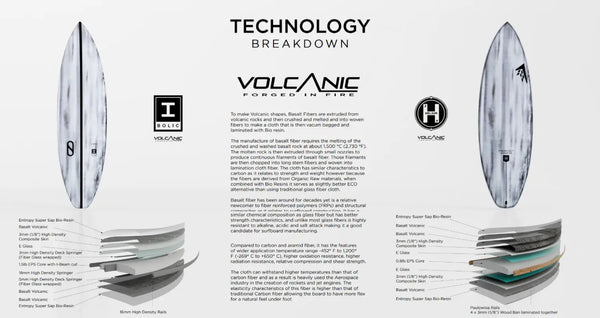
The S Boss comes in Firewire's top builds — Helium, Ibolic, and Volcanic Ash. All three use EPS foam cores and heat-cured epoxy exteriors, which makes them lighter and livelier than traditional polyurethane boards. Dan notes the perceived difference between the construction options is minimal — getting the right size and fins matters far more.
The rocker is based on the Dominator — low to moderate, which is why this board generates speed on flat sections. Dan added an extra 1/8 of an inch of nose rocker per Kelly's preference.
Fins
The S Boss has a five-fin setup. Dan, Kelly, and Kevin Schulz all tend to prefer it as a quad. For quads, size down the rear fins slightly — the pulled-in tail makes bigger, more upright trailer fins too stiff. Thruster works too, same principle on rear fin sizing. Two-plus-one setups have also been tested — large twins up front with a small stabilizer in the back.
Longer raked fronts and knubster options have proven fast and loose on the board.
Kevin Schulz's Review
Kevin Schulz put the S Boss through a full review on video. Here's a breakdown of what he found:
- Speed: The board maintains speed across a wide range of conditions — from overhead point breaks to one-foot beach break. The vee-to-double-barrel bottom was noticeable. Speed came without having to pump for it.
- Fin Setup: Schulz typically rode it as a thruster with larger fins but also ran it as a quad and a five-fin. His verdict: the board adapts well to all three, but the quad configuration gave him the loosest, most responsive feel.
- Sizing: Schulz rides a 5'7" x 28.1" — two to three inches shorter than his normal shortboards. He noted that sizing down is the point. The bullet nose makes it work at shorter lengths.
- Wave Range: Point breaks, beach breaks, slabs. The medium rocker provides control in varied conditions that many pure performance shapes lack. Pipeline specialist Brody now opts for the S Boss's round pin over his normal squash at Backdoor.
Where the S Boss Excels
This is a high-performance shortboard designed for surfers who know what they're doing. It shines on open-faced waves where you can use the explosive power and precision. But the medium nose and tail rocker make it more condition-versatile than a one-dimensional performance shape.
Dan Mann called it the best-performing model he's ever had the pleasure of riding. That's a shaper with decades of designs behind him. The combination of drive on a glassy face and the ability to whip through a critical section makes it a board worth paying attention to.
Dan's personal S Boss is a 5'11" x 20.5" at 30 liters. Kelly and Dan's preferred sizes fall around 5'10" to 5'11". Kevin Schulz rides his at 5'7" — two to three inches shorter than his normal boards.
SHOP S BOSS
Read More: