
The True Ames Greenough 4A Fin: A Legacy of Performance and Innovation
What's Inside
- The True Ames Greenough 4A Fin: A Legacy of Performance and Innovation
- Quick Answer: Which Greenough 4A Size Do I Need?
- Where the 4A Shape Came From: George Greenough, a Tuna, and True Ames
- Key Features of the True Ames Greenough 4A Fin
- Wave Conditions and Surfing Style
- Who the Greenough 4A Is For
- Sizing and Setup Considerations
- The Greenough 4A in Hawaiian Waters
- Comparing the Greenough 4A to Other Fins
- Caring for Your Greenough 4A Fin
- The Future of Fin Design: Building on the Greenough Legacy
- Greenough 4A FAQ
- Why the Greenough 4A Deserves a Place in Your Quiver
True Ames calls the Greenough 4A one of their most popular single fins. In this comprehensive guide, we'll dive deep into its rich history, key features, and why it's become an all-around favorite at our Honolulu surf shop.
Quick Answer: Which Greenough 4A Size Do I Need?
Size the 4A by your board length, and by whether it is your only fin or the center fin of a 2+1 (one big center fin with two small side fins). The center fin of a 2+1 runs smaller, because the side fins share the grip. Here are the sizes for three common longboard lengths:
- 9' longboard: single fin 8.5" or 9". 2+1 center fin 7", 7.5" or 8".
- 9'6" longboard: single fin 8.5" or 9", or 9.75" and up for more hold. 2+1 center fin 7.5" or 8".
- 10' longboard: single fin 9" and up. 2+1 center fin 8", 8.5" or 9".
Heavier surfers pick the bigger end. Every board length is on the sizing chart below, and our team will size it with you in the shop.
Where the 4A Shape Came From: George Greenough, a Tuna, and True Ames

Photo from: https://www.greenoughfilms.com/
The 4A's shape started with a fish. George Greenough, the kneeboarder and designer who changed surfboard design in the 1960s and '70s, traveled to Australia in 1964. One morning there, he went fishing off the beach and came back with a tuna.Bob McTavish, the Australian shaper, tells the story in The Surfer's Journal and in a video from McTavish Surf. Greenough had him look down the tuna's tail. It was thick and solid at the base, then pinched into a fine tip.As Bob tells it, Greenough said the tuna could "accelerate to 35 miles an hour in three seconds," and that tail was the reason.At the time, almost every fin in Australia was a D-fin, a big fin shaped like the letter D. Greenough's fin was tall and narrow instead, what designers call high-aspect. True Ames says that shape let surfers ride closer to the steepest part of the wave and turn harder.In 1966, Nat Young won the World Surfing Championships in San Diego riding Greenough's fin design, and top surfers soon traded their D-fins for it. Greenough kept refining the shape into the early '70s, in what True Ames calls his "Stage 4" tuna-inspired designs.True Ames, founded in 1979 by Chuck Ames, partnered with Greenough to bring his visionary fin designs to the masses. This collaboration resulted in the creation of the Greenough 4A fin, a design that has stood the test of time, still made by True Ames more than 40 years later.
Key Features of the True Ames Greenough 4A Fin
The Greenough 4A fin is renowned for its unique design elements that contribute to its exceptional performance. Let's explore the key features that make this fin stand out:
- Flex Pattern: The 4A fin is crafted with a specific flex pattern that allows for optimal energy transfer and responsiveness in the water. This flexibility enhances the fin's ability to generate speed and maintain control through turns.
- Rake and Sweep: The fin's distinctive rake (angle relative to the board) and sweep (curvature of the leading edge) contribute to its exceptional hold and drive. This design allows surfers to maintain control in critical situations and generate speed effortlessly.
- Foil Shape: The 4A fin features a carefully engineered foil shape that minimizes drag while maximizing lift and drive. This balance results in a fin that feels both fast and responsive.
- Base Width: The wide base of the Greenough 4A provides stability and hold, particularly beneficial when surfing larger waves or performing powerful turns.
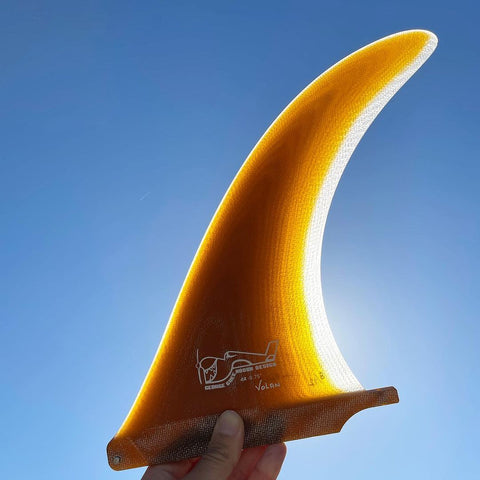
- Materials: True Ames offers the Greenough 4A in various materials, including fiberglass and in Volan. Each material option provides unique performance characteristics, allowing surfers to fine-tune their setup based on personal preference and wave conditions.
Wave Conditions and Surfing Style
The Greenough 4A is built to be genuinely all-around, not suited to one type of wave. Surfers ride it everywhere, from small, playful days to bigger, more powerful surf. The balanced rake, foil, and base width covered above are what let it hold up across that range, instead of specializing in one kind of wave.
Who the Greenough 4A Is For
The Greenough 4A isn't reserved for one type of surfer. Here's who it's built for:
- True Ames' Own Benchmark: It's the shape they size and test every new fin design against, because of how balanced and all-around it performs.
- Any Riding Style: Cruising, driving through turns, or picking up speed, the 4A is built to handle it.
- Nearly Any Board: In True Ames' own words, the 4A works extremely well on just about every type of surfboard.
Sizing and Setup Considerations
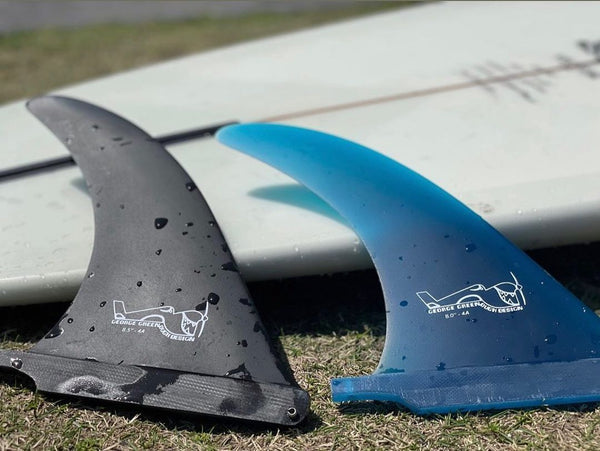
Choosing the right size for your Greenough 4A fin is crucial for optimal performance. True Ames offers the 4A in nine sizes, from 6.5 inches to 10.5 inches (6.5, 7, 7.5, 8, 8.5, 9, 9.75, 10, 10.5). Here's the sizing chart we use in our own shop, based on your board length and setup:
| 2+1, Center Fin | Single Fin | ||
|---|---|---|---|
| Board | Fin | Board | Fin |
| Up to 8'0" | Up to 7.0" | Up to 6'8" | 8.0"–9.5" |
| 8'1"–8'6" | 7.0"–7.5" | 6'9"–7'2" | 8.0"–9.5" |
| 8'7"–9'0" | 7.0"–8.0" | 7'3"–9'0" | 8.5"–9.5" |
| 9'1"–9'6" | 7.5"–8.0" | 9'1"–9'6" | 8.5" and larger |
| 9'7"–10' | 8.0"–9.0" | 9'7"–10' | 9.0" and larger |
True Ames does not make a 9.5" 4A. Where the chart says 9.5", pick the 9", or step up to the 9.75" for more hold.
Board length is the biggest factor, but a few other things nudge the size up or down:
- Surfer Weight: Heavier surfers may benefit from a larger fin size to provide adequate hold and drive.
- Personal Preference: Some surfers prefer the feel of a larger or smaller fin based on their individual style and the characteristics they prioritize (e.g., speed vs. maneuverability).

When setting up your Greenough 4A, pay attention to the fin box placement. Experimenting with the fin position can significantly affect your board's performance characteristics.
The Greenough 4A in Hawaiian Waters
As a Honolulu-based surf shop, we've seen firsthand how the Greenough 4A performs in our own waters, holding up from playful days at Waikiki to bigger conditions on the North Shore.

Comparing the Greenough 4A to Other Fins
To truly appreciate the Greenough 4A, it's worth comparing it to other popular fin designs:
- vs. Traditional Longboard Fins: A traditional longboard fin is built to hold a straight line and resist turning. The 4A's rake and foil trade a little of that straight-line hold for more maneuverability, so riders who want to turn more pick the 4A, and riders who want the smoothest possible trim pick a traditional fin.
- vs. Modern Thruster Setups: A thruster splits the work across three fins for quick, tight turns. A single 4A gives you one connected feel down the whole rail instead, so riders chasing a smooth, drawn-out glide pick the single fin, and riders chasing quick direction changes pick the thruster.
- vs. Other Single Fins: Other single fins tend to lean toward one strength, more hold or more release. The 4A's balanced rake and base width split the difference. Riders who know exactly which extreme they want, maximum hold for heavy power surfing, or maximum release for loose, playful turns, are better off with a more specialized single fin. Riders who want one fin that does both reasonably well pick the 4A.
Caring for Your Greenough 4A Fin
To ensure your Greenough 4A fin continues to perform at its best, follow these care tips:
- Rinse After Use: Always rinse your fin with fresh water after surfing to remove salt and sand.
- Inspect Regularly: Check for any signs of damage or wear, particularly around the base and edges.
- Proper Storage: Store your fin in a cool, dry place away from direct sunlight when not in use.
- Travel Protection: When traveling, use a fin sock or wrap to protect your 4A from dings and scratches.
The Future of Fin Design: Building on the Greenough Legacy
The Greenough 4A continues to influence modern fin design, with many shapers and designers building upon its principles. As surfboard technology evolves, we're seeing new materials and manufacturing techniques that push the boundaries of what's possible in fin performance.At our Honolulu shop, we're always excited to see how innovations in fin design complement the timeless performance of classics like the Greenough 4A.
Greenough 4A FAQ
What size Greenough 4A for a mid-length or shorter single fin board?
Up to 7'2", use the 8", 8.5" or 9". From 7'3" to 9'0", use the 8.5" or the 9".
What size 4A center fin for a 2+1 on a board 8'6" or shorter?
Up to 8'0", use a center fin up to 7". From 8'1" to 8'6", use the 7" or the 7.5".
Does True Ames make a 9.5" 4A?
No. The 4A comes in nine sizes: 6.5", 7", 7.5", 8", 8.5", 9", 9.75", 10", and 10.5". There is no 9.5", so the next size up from the 9" is the 9.75".
What is the difference between the Greenough 4A and the 4C?
True Ames calls the 4C a semi-pivot fin. It keeps the upright shape and small rake of a traditional pivot fin (a fin that turns in a tighter arc), with less surface area. Pick the 4C if you want that pivot-style turn, and the 4A if you want one fin that does a bit of everything.
Can I use the same fin as a single fin and as a 2+1 center fin?
Usually not. A 2+1 center fin is sized smaller because the side fins share the grip, so alone it can lose grip and slip sideways. Buy the size for the setup you ride most.
Is the 4A good for noseriding?
It can be. On a single fin, we size surfers who walk to the front of the board at the larger end of their range, for more hold up front. Surfers who want easier turns go to the smaller end.
Where did the Greenough 4A fin shape come from?
From a tuna's tail. George Greenough studied the tail fins of tuna, one of the fastest fish in the ocean, and built a fin shaped after that tail. True Ames says his tuna-inspired designs led to the 4A.
Does my weight change the 4A size I need?
Yes, and more for a 2+1 than for a single fin. True Ames' own FAQ says weight plays an important role for a multi-fin setup and matters less for a single fin. At Hawaiian South Shore, we put surfers around 185 pounds and up on the bigger size in the 2+1 range for their board, our own call from 30 years of fitting fins across the counter since 1996, backed by the fit feedback customers give us every day.
For a single fin, find your board length on our sizing chart, then start at the smaller size in that range. If you are on the heavier side, step up half an inch to three quarters of an inch, per True Ames' own guidance, whatever your exact weight is.
For example, on a 9'6" board: we start a 140-pound surfer at the 8.5" single fin, and put a 190-pound surfer on the 9" or larger. As the 2+1 center fin on that same board, we use the 7.5" under about 185 pounds, and the 8" at 185 pounds and up or if you are still learning.
If you are still learning, size up either way for stability. More surface area holds you steadier while you find your feet. One of our customers, Randy S., rides a 9'6" Brewer log. He switched from a different 9" fin to the 9" 4A and wrote in his review on our site: "Way more freedom on turning and takeoff. Still holds on nose rides."
Why the Greenough 4A Deserves a Place in Your Quiver
The True Ames Greenough 4A fin has been in continuous production since 1979, and it still delivers speed, control, and responsiveness wherever you ride it.
At our Honolulu surf shop, we're proud to offer the Greenough 4A to our customers. Local or visiting, stop by to feel the fin for yourself and talk sizing with our team.
SHOP NOW
Read More 👈
THE GREENOUGH POWER BLADE FIN FROM TRUE AMES
HOW TO SURF BETTER PART 7 OF 9: CHOOSING THE RIGHT FINS
THE ULTIMATE GUIDE IN CHOOSING A LONGBOARD SURFBOARDS