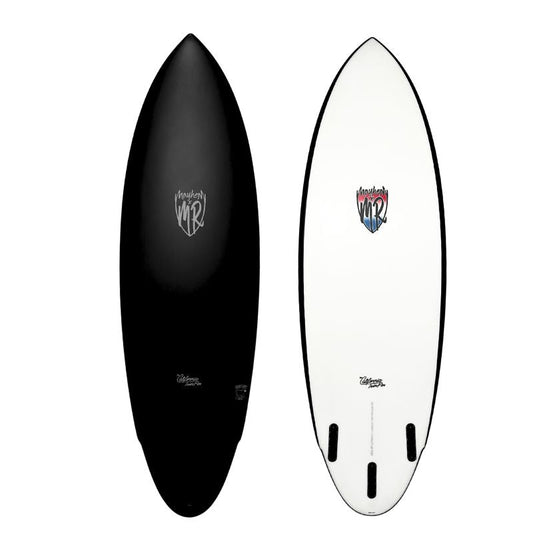


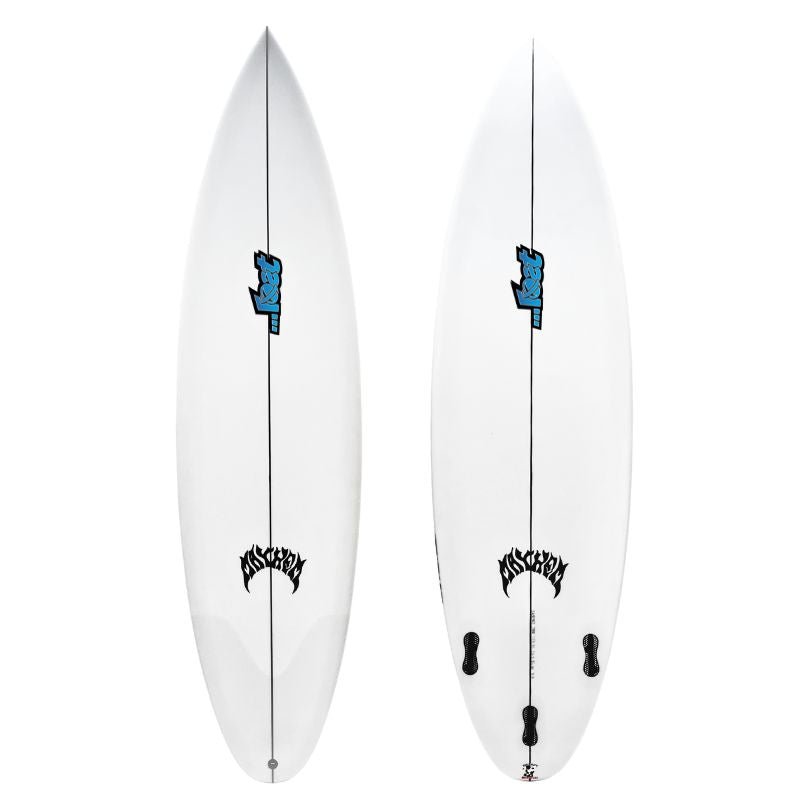
WHAT IS THE DRIVER 3.0 SURFBOARD?
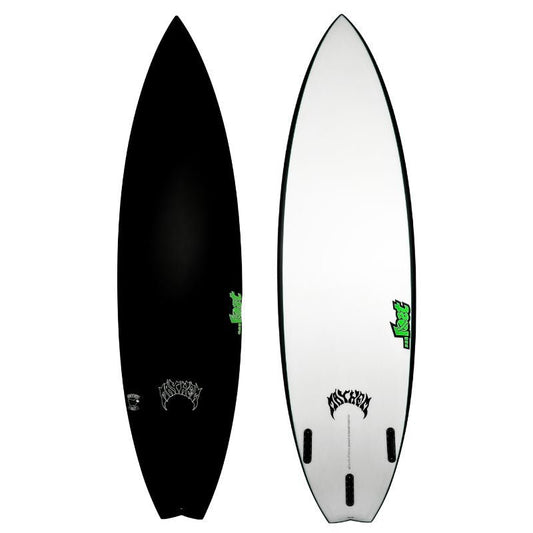
The culmination of three years of refinement and evolution, the DRIVER3.0 is the latest iteration of our high-performance surfboard design. Developed in collaboration with our elite team riders, this board represents the pinnacle of modern surfboard design.
Evolution of a Champion
Since the launch of the Driver2.0 in 2019, our team has consistently pushed the boundaries of what is possible. With input from top-tier surfers like Griffin Colapinto, Kolohe Andino, and Yago Dora, we've refined the design to deliver unparalleled performance.
Key Features
- Slightly more tail rocker: Increased maneuverability and responsiveness.
- Deeper double to single concave: More lift and speed through the rear half.
- Scooped out deck line: Lower, boxy rails for seamless water entry.
- Narrower hip: Added grip and stability.
- Round tail: Forgiving and confidence-inspiring.
- Forward volume: Enhanced glide and responsiveness off the front foot.
Performance-Driven Design
The DRIVER3.0 is designed for high-level surfers seeking a competitive edge. With its refined outline, rocker, and concave, this board delivers:
- Speed: More lift and drive through the rear half.
- Maneuverability: Tight radius turns and responsiveness.
- Stability: Forgiving and confidence-inspiring.
Proven on the World Stage
The DRIVER3.0 has been tested and refined by some of the world's best surfers, including Griffin Colapinto, who rode it to victory in the 2022 WCT events in Portugal and El Salvador.
dims and volumes
- Griffin Colapinto: 5'11 x 28.50 liters
- Yago Dora: 5'11 and 6'0 x 29.50 liters
- Kolohe Andino and Crosby Cola: 5'11 x 29.00 liters
The Ultimate Driver Machine
The DRIVER3.0 is the culmination of years of refinement and evolution. With its performance-driven design and proven track record, it's the ultimate tool for high-level surfers seeking a competitive edge.
POLYURETHANE CONSTRUCTION
PU or polyurethane production is traditional surfboard construction. This was started in the early 60s and to this day is an industry standard. It’s just one of those rare times where we got it right the first time. Polyurethane blank can have a density as low as 2 lbs which is Ultra Light Foam or as high as 12 lbs which is Tow Foam. There are several densities between these but you have to figure out what is the best strength to weight ratio for you.
Obviously, a light board is going to feel the best but it will get destroyed much faster. Can you afford to buy a new short board every two months? A heavy board might last you five to ten years but ride like a slug. Ultra Light Foam is used in the pro short boards and the pro long boards. Since, this foam is light it has the least amount of strength. You should expect to get pressure dings in all boards but this foam will get pressure dings much more frequently.
The best way to reduce pressure dings is to add an extra layer, deck patch or tail patch. Look at the board you have now and see where the most pressure dings are. That is probably where you need a patch. If you are heavy on your back foot a tail patch is fine. If you are heavy only on your front foot a front foot patch is all you need. You may want a ½ deck patch or even a 2/3 patch. There is no sense in a full extra layer unless you are nose riding or looking for a heavier board.
More layers of lighter fiberglass cloth is stronger than an equal weight of less layers. For example, a triple 4oz deck is 12 oz of glass. A double 6oz deck is 12 oz of glass but the triple 4oz deck is going to be much stronger. This is why a deck patch is the best way to reduce pressure dings.
S-cloth is a stronger stiffer cloth than traditional E-glass. It costs more than regular E-cloth but is much stronger for overall strength of the board. If you are breaking boards, you may want to spend a little more on s-cloth for your next board. S-cloth does help in reducing pressure dings but the strength of S-cloth really shines in the over strength of the board. You only need to use S-cloth on the lapping layers to get the benefits of S-cloth.
If you are breaking boards and do not want to spend more money you can ask the laminator to cut bigger laps. This is no additional charge because the excess fiberglass is thrown away. The bigger lap will create a bigger I-Beam on the rail. It will add a little more weight. Most customers ordering big guns will request big laps along with layers of S-cloth.
Another option if you are worried about breaking a board is order a thicker stringer or triple stringer. More lumber equals more strength. It also equals more weight. Most stringers are 3/16 to ¼ inch. US blanks will usually have 3/8 stringers in stock and sometimes ½ inch in stock.
Epoxy is another option for adding strength. Epoxy laminations will add $75 to $200 to the cost of the board depending on the size. Epoxy laminations must be cooked in an oven to cure. If you laminator did not cook your epoxy board it is not cured. This defeats the purpose of spending more money for epoxy.
The strongest board you can order would be a PU blank, laminated in S-cloth and epoxy. The lightest board you could order is a EPS blank laminated in epoxy.
LOST DRIVER 3.0 DIMENSIONS

DRIVER 3.0 BY LOST SURFBOARDS
SHIPPING INFORMATION
Surfboard Shipping
We can only ship boards purchased from the shop at this time due to Cargo policy.
Due to handling requirements, surfboards are shipped with specific protocols and fees.
a. Oahu Store Pickup
HAWAII SURFBOARD SHIPPING RATES
NEIGHBOR ISLANDS:

➤ Hawaiian Air Cargo
(All Size Boards) - ETA Usually in two days (Boards can be picked up from the Hawaiian Air Cargo Airport from 7AM in the morning, a day after the board has been sent out.)
Hawaiian Air Cargo charges $25 per day if the board is not picked up within 48 hours of arrival at their facility.
JAPAN SURFBOARDS SHIPPING
➤ Door to Door

CONTINENTAL USA: SURFBOARD SHIPPING
FedEx Door-to-Door Shipping 🚚
- Boards up to 6'0": $75 flat rate to any Continental US address
- Boards 6'1" to 8'0": Contact us for door-to-door quote
- Delivery: 3-5 business days
Air Cargo Shipping (For boards over 8'0") ✈️
2-day delivery to major airports
Important:
- Airport pickup required within 48 hours
- Must show government ID for pickup
- Let us know your travel dates - we'll time the delivery
- Storage fees apply after 48 hours
West Coast Cities (2-day delivery)
Los Angeles (LAX)
- Shortboard: $110
- Mid-Length: $110
- Longboard: $125
San Diego (SAN)
- Shortboard: $110
- Mid-Length: $110
- Longboard: $125
San Francisco (SFO)
- Shortboard: $110
- Mid-Length: $110
- Longboard: $125
Las Vegas (LAS)
- Shortboard: $110
- Mid-Length: $110
- Longboard: $125
Portland (PDX)
- Shortboard: $155
- Mid-Length: $205
- Longboard: $215
Seattle (SEA)
- Shortboard: $110
- Mid-Length: $110
- Longboard: $125
Salt Lake City (SLC)
- Shortboard: $155
- Mid-Length: $205
- Longboard: $215
Central & Mountain Cities (2-day delivery)
Denver (DEN)
- Shortboard: $165
- Mid-Length: $225
- Longboard: $245
Chicago (ORD)
- Shortboard: $165
- Mid-Length: $225
- Longboard: $245
Minneapolis (MSP)
- Shortboard: $165
- Mid-Length: $225
- Longboard: $245
St. Louis (STL)
- Shortboard: $165
- Mid-Length: $225
- Longboard: $245
Detroit (DTW)
- Shortboard: $165
- Mid-Length: $225
- Longboard: $245
Houston (IAH)
- Shortboard: $165
- Mid-Length: $225
- Longboard: $245
East Coast Cities (2-day delivery)
New York (JFK)
- Shortboard: $110
- Mid-Length: $110
- Longboard: $125
Boston (BOS)
- Shortboard: $110
- Mid-Length: $110
- Longboard: $125
Philadelphia (PHL)
- Shortboard: $165
- Mid-Length: $225
- Longboard: $255
Washington DC (DCA)
- Shortboard: $170
- Mid-Length: $220
- Longboard: $250
Baltimore (BWI)
- Shortboard: $170
- Mid-Length: $220
- Longboard: $250
Atlanta (ATL)
- Shortboard: $170
- Mid-Length: $220
- Longboard: $250
Miami (MIA)
- Shortboard: $170
- Mid-Length: $220
- Longboard: $250
Orlando (MCO)
- Shortboard: $170
- Mid-Length: $220
- Longboard: $250
Tampa (TPA)
- Shortboard: $170
- Mid-Length: $220
- Longboard: $250
South Carolina (CHS) Connecting Flight via SEA
- Shortboard: $225
- Mid-Length: $250
- Longboard: $325
-
LOST Big Rig Driver (6'2 - 7'0) Lightspeed II FCS
通常価格 $945.00 USDから通常価格 -
LOST Puddle Jumper Pro OG (5'2-5'10) Blacksheep
通常価格 $945.00 USDから通常価格 -
Lost Quiver Killer Epoxy (5'4- 6'6) Lightspeed II
通常価格 $845.00 USDから通常価格 -
Lost Party Platter (5'2 - 5'8) Blacksheep
通常価格 $1,020.00 USD通常価格 -
Lost 3.0 STUB THUMB (5'8-6'0) Blacksheep
通常価格 $930.00 USDから通常価格 -
Lost Pisces (5'2-5'10) Blacksheep
通常価格 $950.00 USDから通常価格 -
Lost Sub Driver 3.0 Swallow Blacksheep (5'8 - 6'6)
通常価格 $950.00 USD通常価格 -
Lost MOD Quad Blacksheep (5'2-6'6)
通常価格 $940.00 USDから通常価格 -
Lost RNF 96 Lightspeed (5'3 - 6'1)
通常価格 $895.00 USDから通常価格 -
Lost Sub Driver 3.0 Swallow PU (5'7 - 6'4)
通常価格 $815.00 USD通常価格 -
Lost The Ripper (5'7 - 5'10) FCS II Poly
通常価格 $800.00 USDから通常価格 -
Lost The Ripper (5'5 - 6'2) Lightspeed
通常価格 $910.00 USD通常価格 -
Lost Pisces (5'2-5'11) Poly
通常価格 $830.00 USD通常価格 -
Lost Rad Ripper (5'6 - 5'10) Blacksheep
通常価格 $960.00 USDから通常価格 -
Lost MR x MB California Twin (5'4-5'8) FCS II Lightspeed
通常価格 $905.00 USDから通常価格 -
Lost California Twin (5'5 - 5'9) FCS II Lightspeed
通常価格 $915.00 USDから通常価格 -
Lost RNF Retro Revamp (5'2-6'3) Double Dart FUTURES
通常価格 $1,055.00 USDから通常価格 -
Lost California Twin Pin (5'7-5'9) Black Sheep
通常価格 $965.00 USD通常価格 -
LOST Big Rig Driver PU (5'10 - 6'6) Rounded Squash
通常価格 $820.00 USD通常価格 -
Lost Sub Driver 3.0 Swallow Lightspeed II (5'9 - 6'0)
通常価格 $895.00 USDから通常価格






![Lost Pisces (5'4-5'9) Blacksheep - SHOP SURFBOARDS - [Surfboards Surf Shop and Clothing Boutique Honolulu]](http://www.hawaiiansouthshore.com/cdn/shop/files/5_5_fcs.jpg?v=1740102985&width=533)




![Lost The Ripper (5'7 - 5'10) FCS II Poly - SHOP SURFBOARDS - [Surfboards Surf Shop and Clothing Boutique Honolulu]](http://www.hawaiiansouthshore.com/cdn/shop/files/Lost_The_Ripper_5_7_-_5_10_FCS_II_Poly.jpg?v=1740102880&width=533)
![Lost The Ripper (5'5-6'2) - SHOP SURFBOARDS - [Surfboards Surf Shop and Clothing Boutique Honolulu]](http://www.hawaiiansouthshore.com/cdn/shop/files/lost-lost-the-ripper-5-5-6-2-shop-surfboards-lightspeed-5-5-x-18-50-x-2-25-v24-7-green-logo-fcs-ii-46969775096120.jpg?v=1736904362&width=533)
![Lost The Ripper (5'5-6'2) - SHOP SURFBOARDS - [Surfboards Surf Shop and Clothing Boutique Honolulu]](http://www.hawaiiansouthshore.com/cdn/shop/files/lost-lost-the-ripper-5-5-6-2-shop-surfboards-lightspeed-5-5-x-18-50-x-2-25-v24-7-green-logo-fcs-ii-47727067988280.jpg?v=1740102879&width=533)
![Lost The Ripper (5'5-6'2) - SHOP SURFBOARDS - [Surfboards Surf Shop and Clothing Boutique Honolulu]](http://www.hawaiiansouthshore.com/cdn/shop/files/lost-lost-the-ripper-5-5-6-2-shop-surfboards-lightspeed-5-5-x-18-50-x-2-25-v24-7-green-logo-fcs-ii-47727068021048.jpg?v=1728371207&width=533)

![Lost Rad Ripper (5'6 - 5'10) FCS Blacksheep - SHOP SURFBOARDS - [Surfboards Surf Shop and Clothing Boutique Honolulu]](http://www.hawaiiansouthshore.com/cdn/shop/files/Lost_Rad_Ripper_5_6_-_5_10_FCS_Blacksheep_140193_5.jpg?v=1740110272&width=533)

![Lost California Twin (5'5) FCS II Lightspeed White - SHOP SURFBOARDS - [Surfboards Surf Shop and Clothing Boutique Honolulu]](http://www.hawaiiansouthshore.com/cdn/shop/files/lost-lost-california-twin-5-5-fcs-ii-lightspeed-white-shop-surfboards-5-5-x-19-75-x-2-3-v27-46967757701432.jpg?v=1740103246&width=533)
![Lost California Twin (5'5) FCS II Lightspeed White - SHOP SURFBOARDS - [Surfboards Surf Shop and Clothing Boutique Honolulu]](http://www.hawaiiansouthshore.com/cdn/shop/files/lost-lost-california-twin-5-5-fcs-ii-lightspeed-white-shop-surfboards-5-5-x-19-75-x-2-3-v27-46967757799736.jpg?v=1728373863&width=533)
![Lost RNF Retro Revamp (5'2-6'3) Double Dart FUTURES - SHOP SURFBOARDS - [Surfboards Surf Shop and Clothing Boutique Honolulu]](http://www.hawaiiansouthshore.com/cdn/shop/files/lost-lost-rnf-retro-revamp-5-2-6-3-double-dart-futures-shop-surfboards-5-2-x-19-75-x-2-27-v26-75-46974925373752.jpg?v=1732323896&width=533)
![Lost RNF Retro Revamp (5'2-6'3) Double Dart FUTURES - SHOP SURFBOARDS - [Surfboards Surf Shop and Clothing Boutique Honolulu]](http://www.hawaiiansouthshore.com/cdn/shop/files/lost-lost-rnf-retro-revamp-5-2-6-3-double-dart-futures-shop-surfboards-5-2-x-19-75-x-2-27-v26-75-46974925963576.jpg?v=1728378931&width=533)
![Lost California Twin Pin (5'6'-5'7) FCS II Black Sheep - SHOP SURFBOARDS - [Surfboards Surf Shop and Clothing Boutique Honolulu]](http://www.hawaiiansouthshore.com/cdn/shop/files/lost-lost-california-twin-pin-5-6-5-7-fcs-ii-black-sheep-shop-surfboards-5-7-x-20-00-x-2-40-v29-43150142701880.jpg?v=1732328840&width=533)